
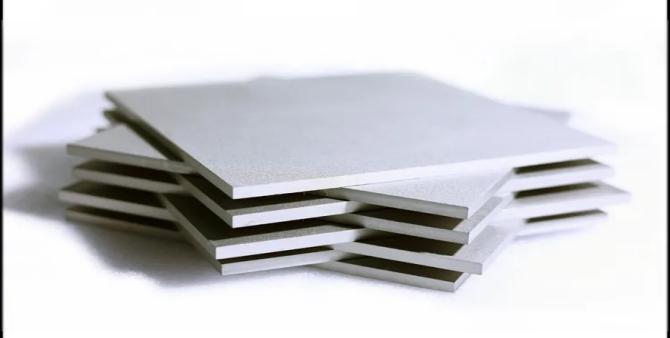
Thin films prepared by sputtering molybdenum oxide targets have important applications in various high-tech fields:
Electronic Devices Field
Thin-Film Transistors (TFTs): In the display industry (LCD, OLED), MoO₃ films can be used as buffer layers, etch stop layers, or source/drain electrodes in TFTs.
Backend Interconnect Process: Due to its excellent electrical conductivity, MoO₂ can be used as local interconnect material or barrier layer in integrated circuits.
Memristors: Memristors based on MoO₃ are a research hotspot in the field of new non-volatile memory.
Display and Optoelectronic Devices Field
Organic Light-Emitting Diodes (OLEDs): MoO₃ is one of the most important hole injection layer (HIL) materials. It has a high work function, which can effectively adjust energy level matching and improve hole injection efficiency, thereby significantly enhancing the brightness, efficiency, and lifespan of OLED devices.
Electrochromic Devices (ECDs): MoO₃ films undergo reversible color changes (coloration/bleaching) under the action of an electric field, and are used in smart windows, anti-glare rearview mirrors, and display devices.
Energy Field
Solar Cells: Used as hole transport layers or interface modification layers in perovskite solar cells and organic solar cells to improve the conversion efficiency of the cells.
Lithium-Ion Batteries: As a component or coating of electrode materials, it can enhance the capacity and cycle stability of batteries.
Sensors Field
Gas Sensors: MoO₃ films have high sensitivity to gases such as ammonia (NH₃) and nitrogen oxides (NOₓ), and can be used to manufacture high-performance gas sensors.
Other Fields
Surface Protection Coatings: MoO₂ films have high hardness and good wear resistance, and are used for surface protection of tools and components.
Decorative Coating: MoO₂ can be sputtered to form distinctive colors (e.g., bronze, black, etc.), which are used for decoration of jewelry, watches, and mobile phone casings.